
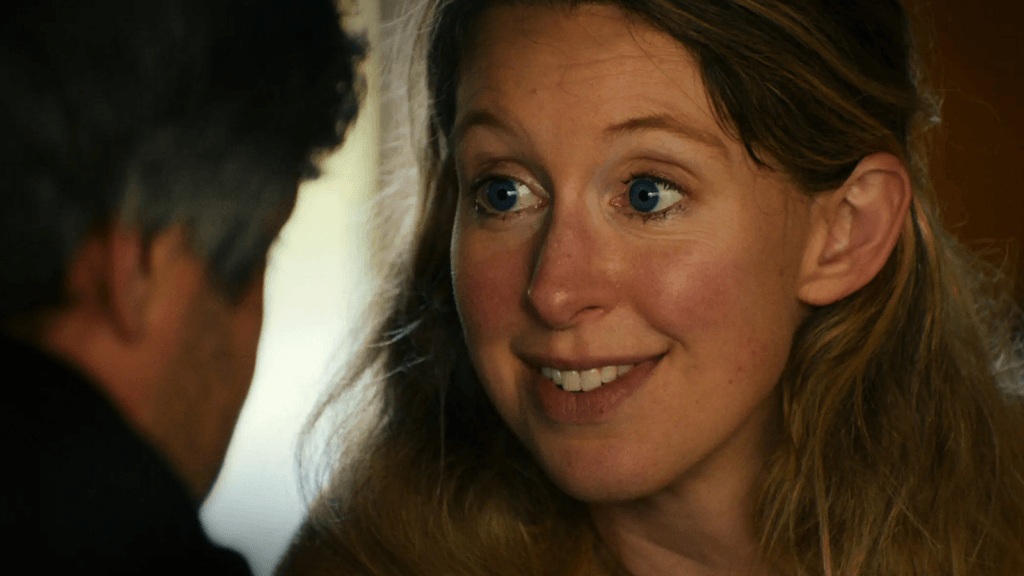
The film of the year and the film for our time
Hello! Before we get into it, I am now on Substack! If you would like to read other future posts, be sure to give me a follow for free here: https://substack.com/@huntmobleymedia
Now without further ado, let’s get into it.
You Can See Everything is really the ultimate culmination of The Nathan Fielder Experience. The creator of Comedy Central’s “Nathan For You” and HBO’s “The Rehearsal” has always exhibited an aptitude for finding absurdity in mundane, and when necessary, poking the bear, or, (even more astutely) no-selling the bear and allowing them to destroy themselves and everything around them by their own volition. In that way, Nathan’s convergence with the sociopathic-like, empty smile Elizabeth Holmes seemed like a match made in heaven. “Isn’t it weird that I, like, did a TV show about kind of a business scam, and you got in trouble for like … a business scam?”
This film is structured into two halves, through which we really drill into three main characters. I really hate to be that guy, but I highly recommend going into this film as blind as you possibly can. With that said, getting into plot-specific spoilers below.
[SPOILERS BELOW]
The first act is sort of the movie that you expect it to be. Nathan joins Holmes, her partner Billy (Silicon Valley tech bro Billy Evans), and her children 34 days before Holmes is set to begin a 135 month prison sentence for the fraudulent claims made by her now infamous and disgraced company, Theranos. Nathan starts with the basic exploration of this family dynamic and their account of what happened and why they did nothing wrong (albeit in a way that only Fielder could), however very early on two themes begin to bubble up to the surface that then become two of the main driving forces of the film.
The first focuses on Liz herself and this idea centered around a quote from a New York Times profile surrounding a statement that she made regarding a character that “she” created which she claims she was misquoted and that she stated the character that “they” (the public/media) created for her. The character of Liz that we see in this film is a far cry from the persona she established enroute to becoming the youngest female billionaire in the world. This Liz is presented as spacey, singularly focused on one goal (Theranos 2.0), and oblivious to basic social cues or even the concept of humor. There is an early scene in which Nathan and Liz debate the use of the word “can” in a statement made to Business Insider regarding the state of their device back in 2015 in which Holmes says “Every test that we offer in our lab can be run on our proprietary devices” when in reality, in that moment it could not (more on this specific example of the use of the word can later). Nathan juxtaposes that to a clip of one of the most famous displays of miscommunication in comedy ever with Abbott and Costello’s “Who’s On First” bit. It is in sequences like these where the marriage between Fielder and co-director Lance Oppenheim and his inclination towards super close-ups feels like a match made in heaven as we are now put in the shoes of Fielder, studying every micro-expression on Holmes face. Holmes eventually starts to chuckle along to Abbott and Costello, but when Fielder interrogates her, it’s clear that she actually doesn’t get it; the comedy is completely lost on her. It’s almost as if she is completely incapable of grasping basic human notions surrounding communication, much less the dramatic irony that can come from miscommunication. Or at least, that is what she wants us to believe.

That then leads to her relationship with Billy. A very interesting moment happens in the first 10 or so minutes of the film in which Liz, while scrambling eggs one morning and talking to Nathan, is interrupted by Billy grabbing the bowl from her, beating the eggs vigorously, and handing them back over. Like many of the best documentarians we have right now, Fielder pounces on this one, seemingly insignificant moment of faux-alpha behavior from Billy. From that point forward, it is clear there is something of a schism between Nathan and Billy that is not there between him and Liz. He plays along to placate Nathan’s desires to discover the “real” Elizabeth Holmes at first (as long as you don’t ask him about his family’s wealth), but he is also territorial over Holmes in a way that goes beyond simply being there to defend your wife from any new negative scrutiny. As if the egg scrambling scene wasn’t enough of a red flag for audiences, we shortly after get a full-frontal shower scene from Billy as if to both flex his physical prowess and directly challenge Nathan like an Ape in the jungle with a literal dick swinging contest over who is the alpha of the house. It’s really quite pathetic. As we tick closer to the date of Liz’s prison sentence, we increasingly see Billy attempt to obfuscate Nathan’s ability to create this documentary, ever present lingering in the background when Liz is speaking or preventing her own parents from providing their insight into the situation or how they got there. But despite Billy’s best intentions, it is clear that there is some sort of undefinable connection between Liz and Nathan. Near the beginning of the film when Liz discusses how her and Billy first became intertwined, she says that her way of flirting is just to stare at the person of interest. This is an interesting angle to bring up so early on in the film as we then have so many repeated lingering shots of Nathan and Liz staring at each other. Is it flirtatious, or are they playing a game of high-stakes poker and attempting to read every imperceptible micro expression on one another. For Fielder as an entertainer, infatuation and fascination are sort of one and the same; either way it makes for compelling viewing.
The day eventually comes when it is time for Holmes to turn herself in to the Bryan Federal Prison in Texas and this is when we get the full act two shift with a title card of “Two Years Later”. We pick back up with Billy, now fully embracing his inner yee-haw and firing ARs at the range. He looks.. uglier. A little thicker yes, but there’s something greasier about his complexion. We learn shortly after that Billy is continuing with many of Elizabeth’s plans for Theranos 2.0 but in every interview, there is something much shorter in temper about Billy’s demeanor. Nathan isn’t even able to talk to Billy’s new business partners about anything of substance without being interrupted, and it is at this point that Nathan understands that he has to make a shift in how he tells the rest of this story. It is in this moment where the lines between reality and fiction really begin to blend as we go full Fielder Method and introduce actress Amanda Seyfried (who famously portrayed Holmes in the Hulu series “The Dropout” in which she won an Emmy). Seyfried is exquisite in this film as she plays fellow investigative journalist alongside Fielder, attempting to get to the bottom of who is the real Elizabeth Holmes and what does she know, and also acts as the Holmes stand-in for “The Rehearsal”-esque recreations of sequences that happened before Fielder, Oppenheim, and crew arrived at the family’s home or after her imprisonment.

Of all the many, many red flags that Billy has exhibited (especially this Billy 2.0), Fielder decides to key in on one specific interaction when the two first met (and recreated by a delightful cameo from Christopher Abbott) that soured his perception of Billy from the jump: asking for financial compensation for participating in the documentary (specifically a cut of revenue). This obviously is a huge ethical qualm that the filmmakers were blindsided with and Nathan even places some of the blame back onto the A24 producers and executives for letting him get away with blackmail in a way that only Fielder could (remember when he compared the Paramount Corporation to Nazi Germany?)
Billy is a very modern villain. He is a certain type of tech bro that could really only exist in a post-Musk buying Twitter/X world where he has more money than he’ll ever need for the rest of his life, but he is so angry and narcissistic that he can’t help but pick fights with strangers on the internet. He’ll happily facilitate the creation of AI versions of his wife to push out into the world (to do whatever heinous things they desire with it) all under the excuse of “well if I don’t do it, someone else will”. This is the same type of guy that takes up a long-term relationship with the former youngest female billionaire in the world and then has the audacity to say, “she will be remembered for building pillars of love for me”. We are really seeing some all-time highs in the world of douchebaggery. These are not a wholly new type of guy; egotistical assholes who are here to profit while the world burns have been around for all of time (see Digger (2026) for another example of this), but this particular flavor is such a uniquely Trump 2 phenomenon that I have never seen quite so artfully articulated on film. He’s one of the most dangerous types of individuals out there because he has lost (or maybe never had) any semblance of empathy. He is so smugly confident that he is right and that he deserves to get his way and what’s worse is he has the money and resources to make it happen.
The inciting incident of Billy asking for financial compensation for this documentary becomes the fulcrum of not only the movie itself, but where to fall on Holmes. Much is made in the first act regarding how Liz has never told a lie, which is then paired with a clip Nathan shows Seyfried where she says “it’s not like I have anything to gain financially from this”. Was she aware of Billy’s attempt to extort money from the project? If not, then that should bring into question for her how much she is blindly trusting him to use her name and likeness on her behalf and maybe put some cracks in those pillars of love. If she was aware, then that brings her entire schtick into question as this straight shooter who was the victim of her own demise. Or, and this is the most likely scenario, was she woefully ignorant of Billy’s actions. Call it being singularly focused on the cause of you’re being optimistic or call it being willfully oblivious as to not implicate herself in any malfeasance.

This is where the film lands and where the camera begins to turn on its Co-Director in Fielder. Billy is the easy villain and it’s easy to see how spending an afternoon, much less the better part of 3 years in communication with this guy would make you hate him, but it’s actually in this dissection of blame pie where Seyfried challenges that clean and easy conclusion. Two big themes in this film are the fallibility of memory and the multiple meanings behind words. When Seyfried and Fielder act out the interaction that Nathan had with Liz in the prison, it all comes down to one word that could either implicate Liz in the financial extortion or, maybe not exonerate, but at least put her in the grey zone (“discussing it” / “discussing something”). When Nathan walks back the script he laid in front of Seyfried, Nathan’s own empathy for this woman, who we have now learned is a victim of trauma who consistently finds herself in these abusive relationships, is challenged. Is he still capable of maintaining absolute objectivity?
The title You Can See Everything calls back to the exchange that the two of them have in Holmes’ home prior to her incarceration regarding the original Theranos prototype. It can do all of these tests in theory if you make a million other assumptions, but as of that time, it was not functional in the way it was promised. In Fielder-Oppenheim’s 3-hour epic documentary, you are capable of seeing everything about this couple’s lives, you can hear all of their words, see how they behave with each other, with their children, with the world; but even after 174 minutes, the conclusions are murky and complicated. We still don’t know who the real Holmes is and if what we are seeing on screen is really her or is this just another character that she (or we) created.
5 Twitter/ X posts from your incarcerated partner’s Twitter/ X Account out of 5


![Stolen Kingdom – Review [Florida Film Festival]](https://i0.wp.com/weboughtamic.net/wp-content/uploads/2025/04/8.jpg?fit=1024%2C576&ssl=1)
![Somnium – Review [Florida Film Festival]](https://i0.wp.com/weboughtamic.net/wp-content/uploads/2025/04/wbam-2025-6.jpg?fit=1024%2C576&ssl=1)
![The Shrouds – Review [Florida Film Festival]](https://i0.wp.com/weboughtamic.net/wp-content/uploads/2025/04/wbam-2025-5.jpg?fit=1024%2C576&ssl=1)
![www.rachaelormont.com – Review [Florida Film Festival]](https://i0.wp.com/weboughtamic.net/wp-content/uploads/2025/04/wbam-2025-4.jpg?fit=1024%2C576&ssl=1)


Leave a Reply