
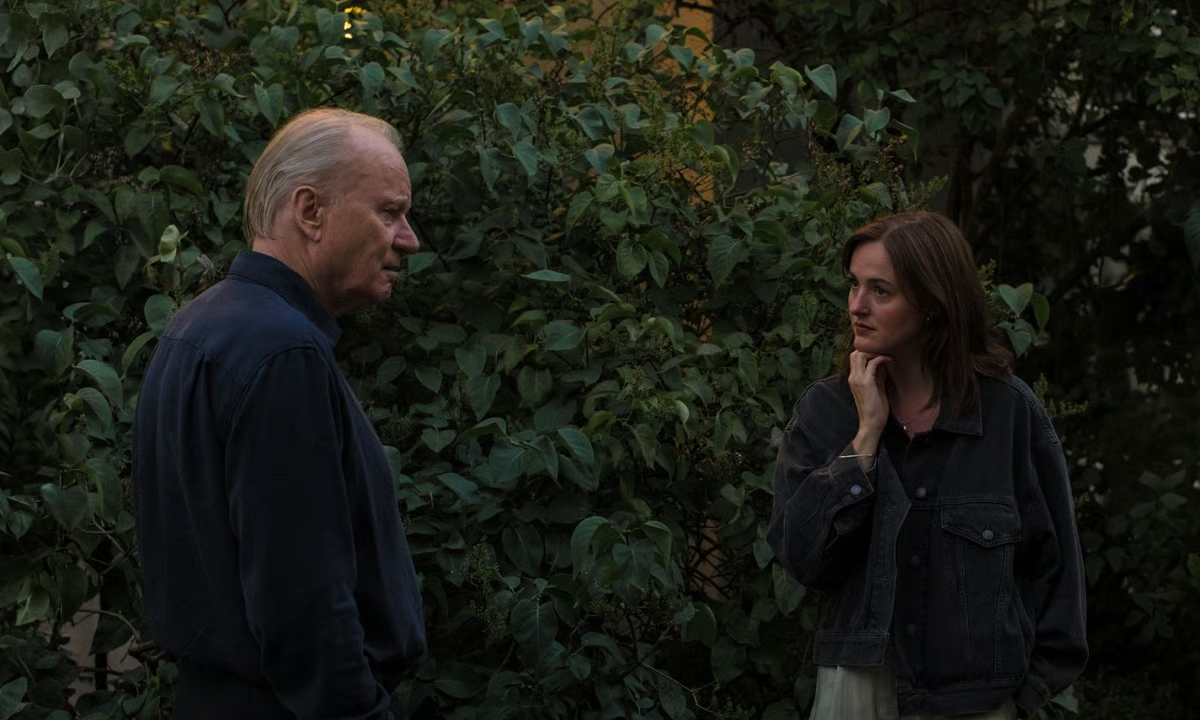
Stellan Skarsgård and Renate Reinsve shine in “Sentimental Value” (2025)
The latest from Joachim Trier is one of the most astounding and emotionally resonant films of the year
– Review contains some minor spoilers for the end of the film –
“Sentimental Value” accomplishes what I might say is the greatest praise that I can give a family drama. It didn’t make me openly weep throughout its runtime because at the end of the day (if Disney movies or Publix holiday ads have taught us anything, it is that) tears are, well, cheap. Instead, for the duration of my time in the theater, it is as though I could feel this invisible pressure, weighing down on my chest. I could feel the constant lump in my throat like I wanted to cry or scream but couldn’t. I found myself holding my breath watching two characters share the same space but then dance around each other instead of talking through their thoughts and feelings. There is something so inherently human about these little moments. About the unspoken that fills the space knowing that there never is going to be that big movie monologue that will suddenly undo the scars of decades of trauma. Instead, all we can do is meet people where they are and try our best to find peace in that.
The latest film from Joachim Trier centers around an aging father (Stellan Skarsgård as Gustav) who, decades prior, left his two daughters to grow up alone with their mother so that he could continue focusing on his filmmaking career. Returning now into the daughters’ lives post the death of their mother, Gustav is on a journey to grapple with unpacking the sins and traumas of his own life through the only way he sees fit, by making a deeply personal story set in the home in which he was raised and where he raised his daughters. The film begins with a question “If a Home could speak, what would it say?” Centering the story around a fixed structure that, at least theoretically, can see all the moments of love and heartache and jubilation and despair not just for your own life, but for the generations that preceded you, is a bit novel even in the day and age where every other movie seemingly is all one big metaphor for generational trauma. But concepts and metaphors only get you so far. Much like the abstract idea of what separates a House from a Home, to be truly moved you need to have Heart, and this movie has plenty of it.

Stellan Skarsgård and Elle Fanning as movie star Rachel Kemp in “Sentimental Value” (2025)
The film centers on Nora (Renate Reinsve), who, like her father, has pursued a career in the arts and despite the apparent success in both of their career paths, both Nora and Gustav, are clearly deeply unsatisfied and unhappy people. The link between the two extends beyond a simple genetic predisposition to classic mental illness diagnosis like depression, but maybe, Trier supposes, we are even destined to follow down the same closed off, self-destructive nature of those who raised us. In Gustav, the script attempts to thread the needle between creating an empathic character you care for while also fully showing you what is, for all intents and purposes, a narcissist who is incapable of relating to those who share different passions than his own. Even in the scene that contained likely the hardest I laughed throughout the entire film in which Gustav shows up with a pile of DVD’s to a child’s birthday party (including, of course every 7 year old’s favorite film, Michael Haneke’s “The Piano Teacher”), there is an underlying sadness to this sequence as it’s clear he’s unable to discern between his own interests and that of a child.
According to her father, every beautiful trait that Nora possesses and every crucial character flaw that causes her to spiral or close herself off is thanks to him. Based on the patterns we see Nora exhibit, is he ultimately right or is the constant reminder of seeing her father in herself leaving her in a suffocating state of arrested development? Nora thankfully has her sister, Agnes, and nephew to ground her slightly more to the real world, but even still she is consistently drawn to the idea of letting it all fall apart every time that things are seemingly going well. There is, of course, the chaos agent part of her that we see nearly blowing up her own play or sleeping with a married coworker, but there is also this repressed scared child who retreats inward at even the possibility of conflict or disappointment. This is the same person who we see ducking out the back door every time her father is about to walk in to avoid any level of confrontation. Nora is a stray cat who prefers the occasional attention of strangers but chooses to keep everyone in her life at arm’s length so she can seclude herself away the moment she feels vulnerable.
However they choose to handle the situations that arise, both Nora and Gustav are deeply lonely people.

Renate Reinsve holding Inga Ibsdotter Lilleaas who plays her younger sister Agnes in “Sentimental Value” (2025)
I’m still trying to fully unpack the ending of this film and the final scene that we see. For a movie that spends so much time in this Home that is bursting at the seam (or quite literally splitting at the foundation) with life and memories and anguish, we end in a cold, white, uber-modern looking film set. Is Trier trying to say that it is only in this location, detached from the generations of pain that surrounds them at Home, that Nora and her father can find real connection? Is using art alone as an outlet for emotional expression ever truly enough, and relatedly, do our two leads turn to art as a way to understand themselves and unpack their feelings or as a form of escape so they can pretend to be someone else without the scar tissue they feel every day?
Are we destined to repeat the same patterns as our parents and their parents and their parents before them?
For all of the lavishly written exchanges between characters, where the movie resonates is in the quiet, nuanced, human moments. This is one of the more genuine portraits of strained familial relationships that I can remember in some time. There are no concrete “yes” or “no” answers to any of the above questions and our characters never articulate all the things they probably wish that they could say to one another. We all grow old and live with things we wish we would have said, things that we wish we could have done differently, and our shared inability to effectively communicate the pains that we feel in the moment and, inversely, be receptive to those pains that we caused without anger or guilt is really one of the most human experiences of all. In Gustav’s film, the door closes before the audience can see the pivotal “action” take place leaving the viewers to wonder “What was she thinking? Why did she do it?”, and maybe that’s the best metaphor we can get for the human experience. Each of us has a door into our soul that we might like to always keep shut to keep ourselves safe, to protect us, to hide away. But we can’t keep the door shut forever. The only way for us to live, to truly live, is to keep the door cracked and let those loved ones in, even if it may lead to hurt sometimes, because keeping the door shut forever is how we become truly alone. This doesn’t necessarily mean that we should all forgive and forget or that we are all destined to have grand therapeutic breakthroughs, but it is more so about coming to peace with what happened in the past and moving forward. Our parents make us who we are, for better and for worse, and like it or not we are reflections of them in the basest biological sense and we all must come to terms with that. That may be different for everyone, but for many of us, like Nora and her father, that may come in the silent moments where nothing is shared but a look and a smile.
And maybe an IKEA stool.
4.5 Missed Drunk Phone Calls from Dad out of 5


![Stolen Kingdom – Review [Florida Film Festival]](https://i0.wp.com/weboughtamic.net/wp-content/uploads/2025/04/8.jpg?fit=1024%2C576&ssl=1)
![Somnium – Review [Florida Film Festival]](https://i0.wp.com/weboughtamic.net/wp-content/uploads/2025/04/wbam-2025-6.jpg?fit=1024%2C576&ssl=1)
![The Shrouds – Review [Florida Film Festival]](https://i0.wp.com/weboughtamic.net/wp-content/uploads/2025/04/wbam-2025-5.jpg?fit=1024%2C576&ssl=1)
![www.rachaelormont.com – Review [Florida Film Festival]](https://i0.wp.com/weboughtamic.net/wp-content/uploads/2025/04/wbam-2025-4.jpg?fit=1024%2C576&ssl=1)


Leave a Reply