
A Complicated (But Ultimately Positive) Review of One of the Most Celebrated Movies of 2024

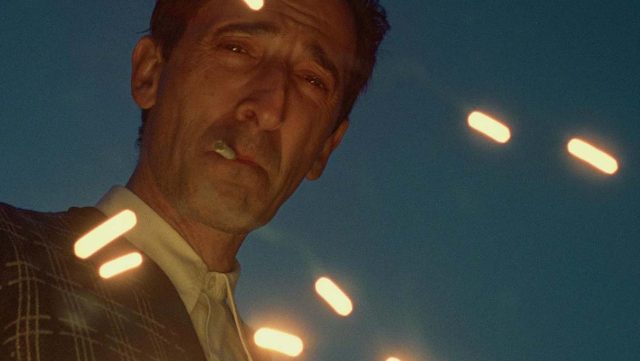
Adrien Brody as Laszlo Toth in the commissioned library at Van Buren Manor in “The Brutalist”, dir. Brady Corbet
After now seeing The Brutalist twice within the span of a few weeks, it’s obvious that much of the plaudits heaped upon this movie and Corbet himself are *through gritted teeth* “undeniable”. From the choice to shoot in VistaVision 70mm to the epic 3.5 hour, fable-like, wholly original nature of the project, there is absolutely something to be celebrated. It would be silly to say that it does not deserve the praise it is garnishing because at the end of the day this is exactly the type of low-mid budget original storytelling that we should be celebrating.
Why then is there also this groaning, self-aware part of me that squirms in my seat when I see a filmmaker who is so clearly, for lack of a better word… Trying.
I think where I’m ultimately coming down on The Brutalist is that it is a better movie to ponder and discuss with others than it is to watch. What I mean by that is that it is a better collection of ideas than it is an engaging story with actual characters. This may come across as a backhanded compliment or an outright criticism, but I don’t even think that I inherently mean it in a negative connotation. After all, isn’t it better to have a movie whose themes and ideas resonate long term as opposed to a big bowl of cotton candy that’s sweet going down but eventually makes you sick?

Courtesy of A24, “The Brutalist”, dir. Brady Corbet
By the nature of the film itself, Corbet (as a writer) bites off more than he can chew, but it is not as though he is giving a flat C+ across the board. Instead we get some plot threads and themes of true genius and others that feel ultimately aimless (primarily in Act 2).
The shortcomings, at least to me, are pretty apparent. Many of the central constructs of the storytelling in this movie simply act to get characters from one place to another leading to dreadful pacing for wide stretches. No matter how many times I rewatch this movie, ultimately Felicity Jones’ Erzsebet is an underbaked and unsatisfying character. And Zsofia might be the biggest missed opportunity of all. I found myself deeply frustrated by her inclusion into the story without then using her as a catalyst to further explore themes like the post Holocaust movement towards Zionism and owning your Jewish heritage, the concept of how trauma can manifest and how her own experienced traumas may have mirrored her uncles (especially in one very dark way we see later in the film); anything more than what we ended up with where we as an audience are made to draw our own conclusions and try to fit the puzzle pieces together.
The good faith argument towards her inclusion (and much of the non-central concepts in the movie where you can feel the gaps) are that it is “up to viewers interpretation”, but there’s a clear difference to me between intentionality in the unsaid versus flatly underwritten and messy.
But even despite these complaints with the storytelling choices made around the fringes of this movie, there are two central thesis at the core of this film that ultimately work:
The first being that for as much as America (at least once upon a time) championed itself as a “land of immigrants”, ultimately you are expected to fall in line with the rest of society or be outcast. The cousin Attila (played by Alessandro Nivola) has already learned this lesson by the time our protagonist Laszlo reaches this country. He left New York for Philadelphia, married a Catholic woman, and changed his Hungarian name to something a little less “exotic” because he had already learned the lesson that Laszlo will come to discover on his own: assimilate, or have the immigrant (and your individuality) ripped out of you by force.
I specifically mention individuality because that ties directly into the second core theme: the importance of creative vision. This is the one that garners the most eye rolls and frankly on its face, it sort of merits them. Where I ultimately come down on it though is that it is a concept that in the day and age of films getting focus-grouped to death and fans and production studios having more power than ever to bastardize a filmmakers original vision, it is necessary. Laszlo, like Corbet, is uncompromising in his quest to make art as he sees it and even if it means killing himself, never again will he put his name on a project he can’t proudly own.
Where a touch of irony kicks in when comparing Laszlo and Corbet together comes with where we conclude the film. The choice to center the architectural language of the movie around brutalism is an inspired choice because ultimately brutalism isn’t trying to inherently say one thing or another, it aims to show something as it is and leave you to draw your own conclusions. In Laszlo’s case, the epilogue of this movie (which in many ways re-contextualizes the film up to that point) depicts a career celebration gala for our Laszlo Toth where smartly, he does not speak about the meaning of his work, but instead others speak for him about his artistic intentions. While Corbet isn’t out writing his own ScreenRant “The Brutalist: EXPLAINED” piece, he is more than forthcoming that this is overtly a movie about the director experience and the importance of Final Cut which, yeah, we could tell.

Director Brady Corbet on the set of “The Brutalist”, photograph by Trevor Matthews / Rolling Stone
Maybe that is why even with these profound and well executed central concepts, I have been finding myself questioning why I cannot throw myself into the fervor of this film in the same way others have. Why is it that I am so resistant to the fanfare and feel the need to neg this movie while also in the back of my head acknowledging that it should be checking all of my own personal boxes?
Ultimately perhaps it is because I am incapable of separating the film itself from the noise around it. You completely lose all semblance of nuance when you have Corbet literally screaming about the importance of directors having Final Cut during acceptance speeches. Maybe it is because this is a film that vacillates wildly between the explicit motifs that hit you across the face with a frying pan (architects are directors, you get that right??) and the insistence upon including other themes that are, at best, underdeveloped. Maybe it is because this is a movie which, sure, has interesting ideas at its center, but is far too rough around the edges narratively to be allowed to skip the line and immediately crowned a masterpiece. The movie has only just begun to release wide in the last couple weeks yet it so clearly has aspirations beyond being merely considered a critical indie darling. If you don’t believe me, all you have to do is look at every single piece of marketing material surrounding this movie all pushing the same word: “Monumental”.
The whole thing warrants a bit of an eye roll.
I feel like Stephen Malkmus snidely looking down at Billy Corgan and rival Smashing Pumpkins in the 90’s as a bunch of try-hards. Unlike the Pavement front man though, I will at least acknowledge that I recognize the importance and the craft of Corbet and Co’s film. I don’t want to be the edgy film guy trying to launch a take down on one of the objectively most well made movies of the year, but at the end of the day I feel myself erring on the side of pumping the brakes.
Is this a very good movie, with Great, perhaps even transcendent moments? Yes. Does it meander and lose itself, finding certain plot threads underbaked and unsatisfying? Yes. Is it visually striking and an achievement in direction? Yes. Is it inherently pretentious and at times quite alienating? Yes. Does it contain incredibly layered notions that warrant dissection and discussion? Yes.
Despite its flaws, is it still worthy of being exalted into the annals of film history as the Best Film of 2024? Only time will truly tell.
3.5 ba da dum dums out of 5


![Stolen Kingdom – Review [Florida Film Festival]](https://i0.wp.com/weboughtamic.net/wp-content/uploads/2025/04/8.jpg?fit=1024%2C576&ssl=1)
![Somnium – Review [Florida Film Festival]](https://i0.wp.com/weboughtamic.net/wp-content/uploads/2025/04/wbam-2025-6.jpg?fit=1024%2C576&ssl=1)
![The Shrouds – Review [Florida Film Festival]](https://i0.wp.com/weboughtamic.net/wp-content/uploads/2025/04/wbam-2025-5.jpg?fit=1024%2C576&ssl=1)
![www.rachaelormont.com – Review [Florida Film Festival]](https://i0.wp.com/weboughtamic.net/wp-content/uploads/2025/04/wbam-2025-4.jpg?fit=1024%2C576&ssl=1)


Leave a Reply